

Manual Dumpster Tracking vs. Automated Software Systems
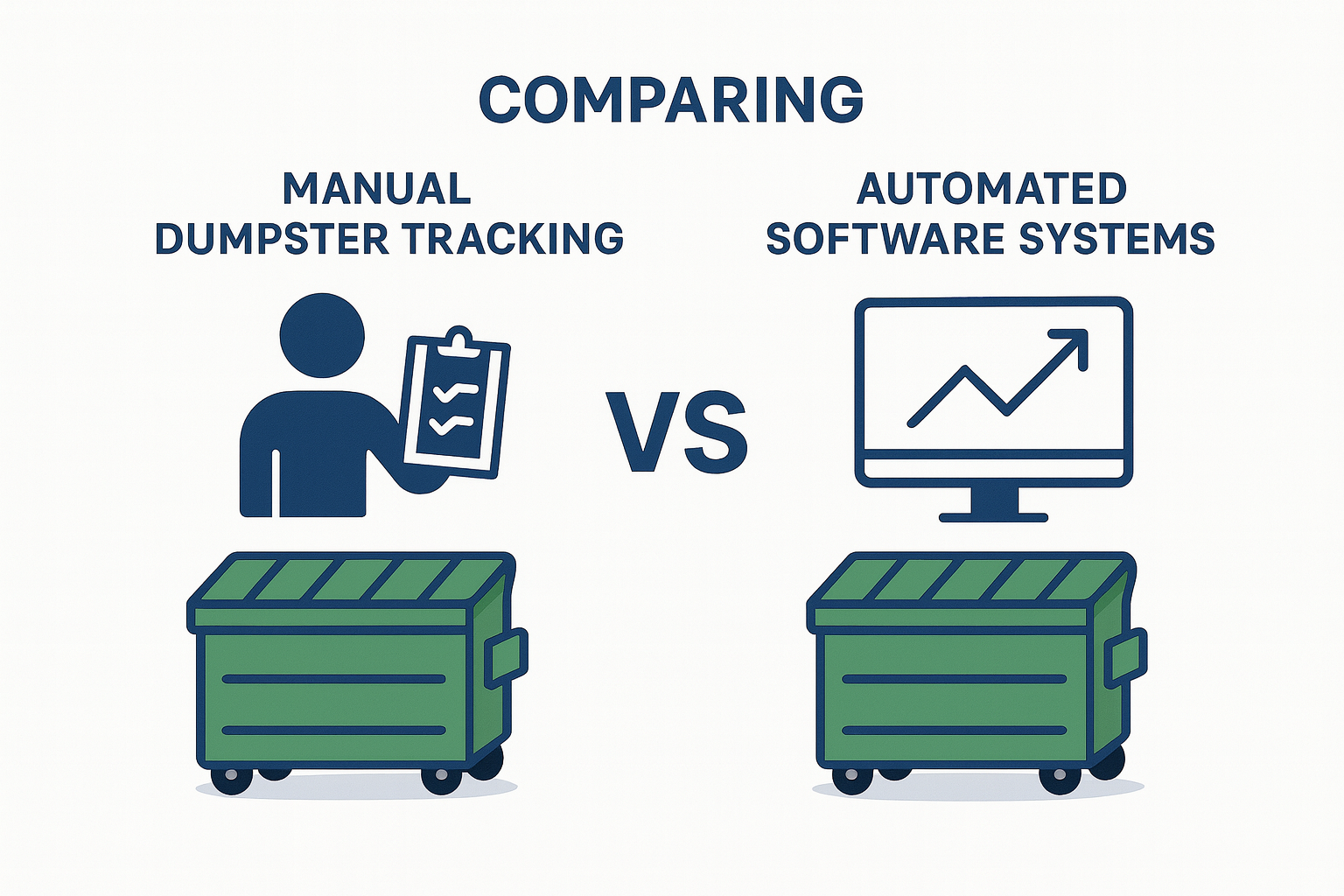
For the facilities managers, site supervisors, and waste management teams, the humble dumpster is a major budget item and constant operational challenge. The fundamental question is deceptively simple: Do you have your containers where you pull your trash and recycle, and are they fully serviced? For years, the response was to use manual processes, clipboards, phone calls, and spreadsheets. Today, there are automated software systems to consider. This isn’t just a convenience comparison; it’s the real impacts on efficiency, cost, the accuracy of a company’s bottom line, and the environmental footprint.
1: The Manual Method: A System of Inherited Inefficiencies
Manual tracking is well-known. It usually means drivers or site managers writing down collections on paper tickets, which are then assembled in an office. Dispatchers rely on physical whiteboards or basic calendars to manage bookings (with the assumption of standardized weekly schedules and not based on actual demand). Communication regarding missed pickups, overfull containers, or site access restrictions is reactive and handled through calls and emails.
This all looks very straightforward at first glance. But the real cost is in inefficiencies and “soft” losses that add up.
Operational Delays and Reactive Workflows
In the absence of real-time data, problems only become evident after they occur. A dumpster overflowing on a Tuesday might not be reported until Wednesday, causing possible code violations, employee downtime, or unsightly conditions. The response is always reactive, wasting management’s time in firefighting rather than planning.
The High Cost of Human Error and Ambiguity
Illegible tickets, lost paperwork, and data entry errors are par for the course. A report from the Environmental Research & Education Foundation noted that errors in waste tracking data are an obstacle for companies looking to increase recycling rates and reduce costs. These mistakes can result in overcharging customers, pricing internally, and selling a misleading view of waste generation patterns.
Inefficient Routing and Fuel Waste
Unoptimized routing is often habitual rather than logical. A driver may visit a half-full container on a fixed schedule while another location is overflowing. It leads to wasted miles, excess fuel consumption, and wear and tear on vehicles, and those are all costs that either get passed directly to the customer or absorbed through reduced profit margins.
Limited Data for Strategic Decision-Making
Manual systems offer data points, not intelligence. It is tough to get trends from month to month or year to year using paper tickets. Questions such as “Are our waste costs increasing at this location?” or “Should we downsize a container and move to a bi-weekly service?” require painstaking manual audits, which are seldom conducted proactively.
2: The Automated Software System: Data-Driven Operational Control
Automated tracking systems replace clipboards with smartphones and centralized digital platforms. They use GPS, cellular data, and cloud computing to provide live visibility of containers. The core function is basic: giving the right information to the right person at the right time.
The operational shift is transformative:
Proactive Management with Real-Time Visibility
Managers and dispatchers have a dashboard with all container locations and statuses, collected by sensor technology. They can tell which containers are close to being full or were just emptied. This enables pre-emptive scheduling and avoids overflow incidents before they occur.
Dramatic Reduction in Administrative Errors
Digital pick-up confirmations are time-stamped and geotagged, ensuring instant synchronization. This generates an unalterable record of service, eliminating disputes over billing as errors in internal accounting. The information is structured and accurate from the time it is collected.
Optimized Logistics and Concrete Cost Savings
Advanced software takes into account the service history and real-time requirements to construct optimized routes for the drivers. This reduces the total miles driven, fuel costs, and allows a driver to service more containers in a single shift. The savings here are immediate and measurable, and often pay for the system on their own.
Strategic Insights from Actionable Data
Automation systems convert waste processes into business intelligence. Reports can be generated by site, material type, and cost over time. This enables managers to confirm recycling program results, potentially identify opportunities to right-size their container fleets, negotiate better rates with waste haulers based on accurate historical data, and, in some cases, apply accurate waste cost calculations to customers or internal departments.
3: A Direct Feature Comparison: Understanding the Shift
In terms of data accuracy, manual tracking is error-prone due to illegible handwriting, lost tickets, and errors in spreadsheet data entry. On the other hand, an automated system guarantees accuracy from the beginning, by generating digital records that are time-stamped and geotagged in the field, at the moment of service, with no room for ambiguity.
When it comes to problem response, manual processing is inherently reactive. Teams have to wait to be called or observe an overflowing bin before responding. Automated software promotes a proactive mentality, alerting dispatchers when sensors detect a bin is nearing its capacity, allowing service to be scheduled before a problem even arises.
Routing efficiency differs drastically. Manual routing is typically done using standardized, predictable routes that don’t always focus on actual needs, wasting fuel and labor. These systems use real-time container status and location data to dynamically optimize routes by consolidating trips and ensuring drivers visit only necessary locations, resulting in a direct reduction of fuel consumption and vehicle maintenance.
Billing and accounting are now different processes. The manual process of turning paper tickets into invoices, a slow, error-prone process that all too often results in billing disputes. Precision-checked, validated invoices are generated by automated software directly from the digital service record, simplifying accounts receivable and cash flow.
The availability of managerial insights is perhaps the most significant point of differentiation. Manual data collection only provides limited and retrospective information, which is challenging to interpret and insufficient for informing strategic decisions. An automated system provides information-rich reports on waste volumes, service frequency patterns, and cost profiles over time, enabling managers to make well-informed decisions to reduce costs and enhance sustainability.
Finally, scalability presents a clear contrast. To scale a manual business, you’ll have to hire more admins and managers to accommodate the growing volume of paperwork and communications. Yet, automated software is scalable by nature; the increased load of data and containers can be administered efficiently by the system itself, letting the business expand without the need for a proportional increase in the administrative overheads.
Conclusion
The decision between the manual tracking of dumpsters and an automated system does not only have an aspect of implementing a new technology. It is a strategic choice concerning the management of a recurring and expensive, logistically difficult operation.
Manual systems, though not new, are costly due to inefficiency, error, and missed opportunities. They maintain operations in a responsive position. The automated software solution turns waste management into a method of managing logistics into a data-rich, streamlined, and programmed aspect of facilities management. The ROI is achieved not as buzzwords, but as a set of measurable indicators: a decrease in the number of calls to the emergency service, decreased fuel expense, reduced hours on administrative work, and the ability to make strategic decisions grounded in facts rather than assumptions. To any organization that values cost control and operational efficiency, an upgrade to an automated system is not an IT purchase, but it is an essential operational upgrade.
FAQs
1. What is the biggest cost saver with automated tracking?
The most direct savings come from optimized routing and fuel efficiency. The system avoids unnecessary container visits that do not require service, which greatly reduces the number of miles, fuel expenses, and wear on the vehicle.
2. Is the software difficult for drivers to use?
No. Responsible systems are typically equipped with simple mobile interfaces in which drivers can verify a service in a matter of a couple of taps. It eliminates bulky paperwork, and most of the drivers confirm that it streamlines their daily tasks once adopted.
3. Does this software integrate with our existing business systems?
Yes, one of the major characteristics of reliable platforms is their ability to integrate. They are able to generally export authenticated service information to accounting packages to enable automatic billing, and to ERP systems to enable efficient cost distribution.